
E-commerce & Retail
Summarise with AI
Zendesk for retail: one customer, online and in store.
Your customers buy online, return in store and ask about stock before they drive in. We connect your website, your stores and your support team in one Zendesk, so every conversation carries the whole story, even in November.
- Online and in-store history in one view
- Store teams in the loop, without a full seat
- “Where is my order?” answered automatically
- An AI agent for product questions, 24/7

★ 5.0Zendesk Marketplace

 Run by ex-Zendesk people

Zendesk Rescue · AU/NZ, EU and NA, through Q4 peak
- ↓ 79%EU first reply22.8 hrs → 4.7 hrs
- 4.6Trustpilot ratingup from 2.7, 700+ reviews
- +31%NA peak volume absorbedresolution still faster
- ↓ 66%AU first reply12.6 hrs → 4.3 hrs
Our customers
Trusted by retailers who can’t afford a slow November
From footwear sold in three markets to bedding sold in stores across Australia, here is what retail teams say about working with us.


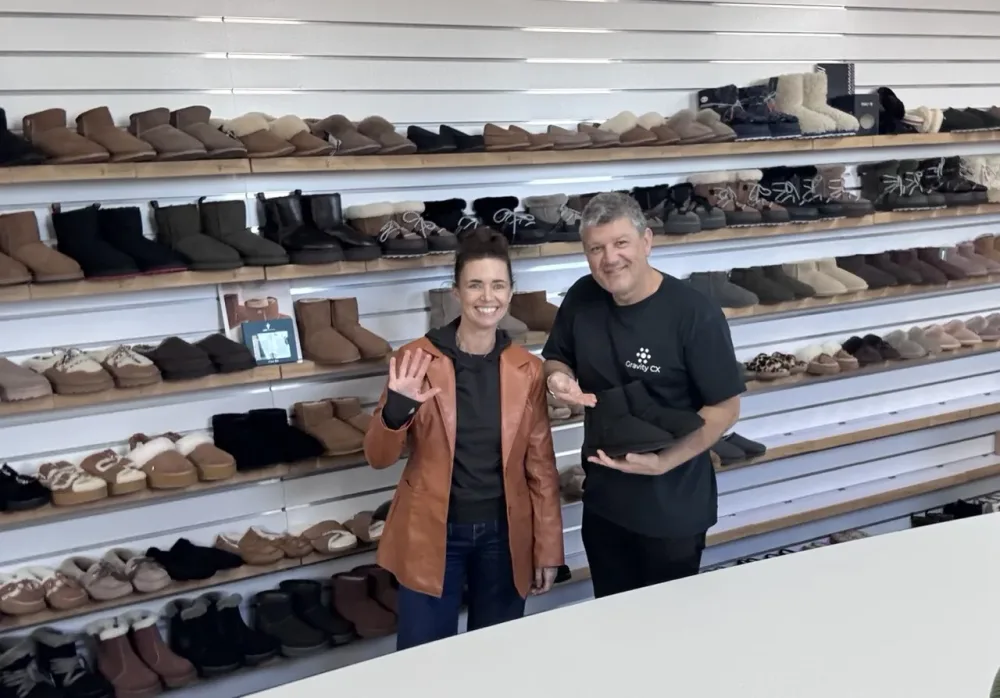
“We knew something was not right with our setup but could not pinpoint where. Gravity CX diagnosed and fixed everything quickly, including problems we did not know about. The monitoring view they set up means we will catch anything like this much earlier next time.”

 Alex StepinsCustomer Experience · EMU Australia
“The AI agent did not just take tickets off our plate, it gave our people a new career path. Three of our support team moved into sales because the AI was handling the volume, and our customers get answers the moment they ask.”
 Jamie HoweHead of Customer Operations · The Bart Group
“Gravity CX made our migration and setup seamless. Their team was professional, knowledgeable, and went above and beyond to ensure everything was perfectly tailored to our needs.”
 Caroline LeeAdministration Officer · Australian Learning Group
“Before Gravity CX we were largely going through the motions. We have since rebuilt our foundations and significantly improved our Zendesk platform. Our workflows are structured and efficient, and we have a clear roadmap for what to tackle next.”
 Chris JamesHead of Customer Operations · Ezypay
“In just two weeks they had us fully operational. Despite our unusual use of Zendesk they adapted seamlessly and helped us develop solutions that worked, delivering outstanding value in a short period.”
 Stacey YoungOperations Manager · NGS Structural Engineering
“Outstanding support setting up our Zendesk reporting, delivering a solution that exceeded our expectations. Chad went above and beyond to tailor the structure to our needs, with clear communication at every stage.”
 Dorota BacalSustainability & Innovation Lead ANZ · Arkance
“Gravity CX was instrumental in our transition to Zendesk, implementing across multiple departments. We have streamlined our operations and improved our customer experience.”
 Sophie CarpenterHead of Customer Care · Mycar
“Their expertise and hands-on approach ensured a smooth onboarding for our team. The support and training were outstanding, and they were always responsive and professional.”
 Sean EdwardsMember Service Manager · My Weight Loss Clinic
“Gravity CX transformed our Zendesk setup, making it a powerful tool that aligns perfectly with our operational needs.”
 Cameron WykAfter Sales Team Leader · Midea
“This is us implementing AI in the business in a considered way, with a trusted partner who already knows the product.”
 Kat BeavonCOO · REIQ







Online and in store
Your customers don’t see channels. Neither should your support.
Most retail support stops at the website. The questions that cost you customers sit between the website and the store. We bring both into one Zendesk.
Online
- Your Shopify store, chat and messaging
- Orders and refunds
- Tracking and delivery
- Reviews and social
One customer, one history
Every order, purchase, return and conversation, whichever door they came through.
In store
- Store purchases, from Pronto POS and EFTPOS
- Click and collect
- Returns at the counter
- Store staff and store hours
Online→Store
Bought online, returning in store
The store finds the online order in seconds, and the refund shows on the customer’s ticket. No “we can’t see web orders here”.
Online→Store
“Is it in stock at my store?”
The AI agent answers stock, store hours and directions before the customer drives in.
Store→Online
Click and collect isn’t ready
The customer messages, the ticket goes to that store’s team, and they reply from the floor, not from a shared inbox.
Store→Online
A fault with an in-store receipt
The in-store purchase is on their profile, so the warranty claim starts online without a photo of a crumpled receipt.
Store→Support
Store staff need a hand
Stores raise questions to head office in Zendesk, with light-agent seats or side conversations, not personal mobiles.
Online→Store
Advice after hours, sale in store
Product questions answered by AI at 10pm, then the customer walks in the next day already decided, as at the Bart Group.
The WISMO and refunds pattern
Most of your queue is the same five questions. Only one needs a person.
The economics of retail support come down to whether these are answered by your help centre, by automation, by AI, or by an agent. We build it deflection first.
~70%of a typical retail queue is these five questions.
Where is my order?
Tracking pulled from Shopify and your carrier, answered in messaging and the help centre before a ticket exists.
AutomatedWhere is my refund?
Refund state read from the order, so the answer is the real one, not “allow 5 to 10 days”.
AI agentCan I exchange this?
Your exchange rules in the help centre, and the exchange started in Loop without leaving the chat.
Self-serveWhere do I return this?
A returns flow that books the label, and a ticket only when the item is outside policy.
Self-serveWhy was I charged this?
Routed to a trained agent with the order, payment and customer history already in the ticket.
An agent, with context
Retail results
Two retailers, and what changed.
Footwear · AU/NZ, EU, NAEMU Australia: one Zendesk for three markets, ready for Q4
We rebuilt views, macros and triggers for three regional teams, put Copilot beside every agent and rebuilt messaging to deflect the repeat questions, before peak.
- ↓ 49%EU first resolution
- 2.7 → 4.6Trustpilot rating
- +31%NA Q4 volume, handled
“We knew something was not right with our setup but could not pinpoint where. Gravity CX diagnosed and fixed everything quickly, including problems we did not know about. The monitoring view they set up means we will catch anything like this much earlier next time.”
Alex StepinsCustomer Experience · EMU AustraliaFurniture & bedding · stores and onlineThe Bart Group: support turned into revenue
Sleeping Giant, James Lane and sister brands run a large store network and a growing online business. An AI agent answers product questions in and out of store hours, so the team moved on to selling.
- ~2,000AI conversations a month
- 3agents moved into sales
- 24/7product answers
“The AI agent did not just take tickets off our plate, it gave our people a new career path. Three of our support team moved into sales because the AI was handling the volume, and our customers get answers the moment they ask.”
Jamie HoweHead of Customer Operations · The Bart GroupAI for retail
AI that answers shoppers, and AI that helps your team.
Retail has the clearest case for AI in support: high volume, repeat questions, and answers that live in your store’s data.
For your team
Faster replies, with the order in view
Inside Zendesk, beside every ticket.
- Replies drafted from your policies and the customer’s order, ready to edit.
- Tickets triaged by intent: order, return, exchange, fault or pre-sale.
- Long threads summarised before an agent picks them up.
- The right macro suggested for the case in front of them.
Zendesk Copilot, tuned to your workflows, as at EMU.
For your shoppers
Answers before they ask an agent
In chat, messaging and the help centre, any hour.
- Order status and refund state answered from Shopify.
- Returns and exchanges started without a ticket.
- Product questions answered from your catalogue: sizing, fit, care, and stock at nearby stores.
- Store hours, click and collect status and directions, before they drive in.
A Zendesk AI agent trained on your catalogue, as at the Bart Group.
“The AI agent did not just take tickets off our plate, it gave our people a new career path. Three of our support team moved into sales because the AI was handling the volume, and our customers get answers the moment they ask.”
Jamie HoweHead of Customer Operations · The Bart GroupThe peak playbook
Peak, planned: a playbook, not a hiring spree.
Black Friday, Christmas, Boxing Day, EOFY. You don’t staff for peak all year: you switch the playbook on when you need it and wind it back after.
- 6 to 8 weeks out
Prepare
Help centre and AI answers updated for cut-off dates, promotions and delivery times. Temporary agents onboarded with their own views and macros.
You getA queue that’s ready before the traffic is.
- Peak week
Surge
Surge automations switch on: order status pushed proactively, routing tightened, and deflection raised a level so agents only see what needs them.
You getResponse times that hold when volume doesn’t.
- After delivery
Returns season
The returns and exchange flows take the spike, and the AI agent answers refund questions from the order itself.
You getReturns handled without a backlog.
- After peak
Wind back and review
Temporary access removed, surge rules switched off, and a review of what peak taught you, ready for next year.
You getA cleaner Zendesk than before peak.
EMU’s North America team took 31% more tickets in Q4, and resolved them faster than the year before.
Integrations
Your store’s data, inside the ticket.
We work with Shopify every week, and connect your store’s POS and EFTPOS too, so online orders and in-store purchases show in Zendesk, not in a tab your agent has to switch to.
 Our most common integration
Shopify and Shopify Plus
Orders, fulfilment, tracking, refunds and Shopify POS sales, inside every Zendesk ticket. Refunds and edits made from the ticket.

Pronto
In-store POS and EFTPOS: store purchases on the customer’s profile.



BigCommerce, WooCommerce and Magento
Orders and customer history.

Loop
Returns and exchanges.


AfterShip and ShipStation
Tracking and delivery.


Klaviyo and Recharge
Profiles, flows and subscriptions.
What your agents see
- Every order, online and in store, with status and tracking, in the ticket sidebar.
- Tickets routed to the right store, where the customer shops.
- Refunds and exchanges started from the ticket, not another admin.
- VIPs and repeat buyers spotted and routed first.
- Moving from Gorgias, Help Scout or Freshdesk? We migrate your history too.
Multi-brand retailers
Two brands, two Zendesks? One Zendesk, every brand.
If you run more than one brand, you’ve probably ended up with two instances by accident, or crammed everything into one and nothing routes properly.
Where most retail groups are
Two instances, or one tangle
- Agents log in twice, or see every brand’s tickets mixed together.
- Brands share triggers they shouldn’t, and returns go to the wrong team.
- One brand’s help centre answers another brand’s customers.
- Reporting can’t compare brands, or regions, side by side.
What we build
One Zendesk, every brand
- Each brand with its own help centre, forms, email and messaging.
- Routing by brand and region, so tickets reach the right team.
- Shared agents where it helps, separate views where it doesn’t.
- One report across brands, and one per brand.
EMU runs three regions this way; the Bart Group runs Sleeping Giant, James Lane and sister brands.
Where to start
Which engagement is right for your retail team?
New retailer or replatforming
Zendesk Implementation
Launching Zendesk for a new DTC brand, or moving from Gorgias, Help Scout or Freshdesk, with your store integrations built in.
Your Zendesk is getting messy
Zendesk Rescue
Years of macros, brands sharing rules they shouldn’t, returns routing through the wrong team. We rebuild it before your next peak.
Healthy Zendesk, growing brand
Managed Zendesk
The setup works, but you want someone improving it every month, through peak and beyond.
Questions we get on the call
Before you book
- What is the WISMO and refunds pattern, and how do you solve it?
Most e-commerce support queues are 70% the same five questions:
Where is my order? Where is my refund? Can I exchange this? Why was this charged? Where do I return this?The economics of e-commerce support depend on whether those five questions are deflected, automated, or escalated to a human agent. We build the deflection-first stack: a help centre built around those questions, Zendesk AI for ticket triage, and automation rules for WISMO, so agents only see the cases that actually need a human.
- What e-commerce platforms do you integrate Zendesk with?
Shopify, BigCommerce, Magento, Returnly, ShipStation, Klaviyo, Loop, and Recharge. The order-lifecycle integration surfaces order status, fulfilment, tracking, and refund state inside the Zendesk ticket, not in a separate tab your agent has to switch to.
- How do you handle peak season?
We have a pre-built peak playbook:
Temporary agent onboarding, surge automation, deflection escalation, and post-peak cleanup.
We run this every November. You don’t staff for peak year-round; you deploy the playbook when you need it and wind it back after.
- We have two retail brands and two Zendesks can you consolidate them?
Yes, multi-brand consolidation is a standard engagement for us. If you’re rebuilding from scratch with both brands, that’s an implementation. If you’re untangling an existing mess, that’s a Rescue. Either way, the output is one Zendesk instance with proper multi-brand routing, separate views, and brand-specific ticket forms.
- Which engagement is right for a retail team?
Three paths:
- New retailer or replatforming → Implementation (4–6 week fixed-price launch with your platform integrations built in)
- Existing Zendesk that’s messy → Rescue (we rebuild what’s broken)
- Healthy growing brand → Managed Zendesk (monthly managed service, named consultant, quarterly reviews).
Book a call
One customer, online and in store. Let’s map it.
We’ll map how your website, your stores and your support team should connect, and your peak playbook before the next Black Friday.
You will get a calendar invite with a video link straight away.
- A call about your store, your queue and your peaks.
- How your website, stores and support should connect, mapped.
- The right engagement, and a written plan.
Who you might be speaking with

Hugo Richard
Head of Growth, ex Zendesk

Chad Susa
Founder, Head of Service, ex Zendesk